God of War: Ghost of Sparta Story Explained: The Forgotten Brother and the Prophecy of the Marked Warrior

📋 Quick facts
- Game
- God of War: Ghost of Sparta
- Developer
- Ready at Dawn (with additional support from Santa Monica Studio)
- Release year
- 2010 — November 2, 2010 in North America; November 3 in Europe (PSP)
- Original platform
- PlayStation Portable (PSP)
- Genre
- Action-adventure, hack and slash
- Director / Writer
- Directed by Dana Jan — Written by Cory Barlog
- Music
- Gerard K. Marino and Mike Reagan
- Notable feature
- The only entry to explore Kratos's family (his brother Deimos and mother Callisto); explains the origin of the red tattoo and the "Ghost of Sparta" nickname; Thera's Bane replaces the Rage mechanic; its graphics were considered a technical pinnacle for the PSP
- Story placement
- The fifth entry in chronological order: after God of War (2005), before God of War II (with the mobile game Betrayal in between)
Kratos has killed a god and taken his throne. From the heights of Olympus, he now rules over war with a rage that has become legend. Yet every night, the new God of War is woken by visions of his mortal past — and at the center of every nightmare stands a boy he could not protect: Deimos, his lost younger brother.
God of War: Ghost of Sparta is the sixth released entry in the series (2010, a PSP exclusive developed by Ready at Dawn), but in the story's chronology it stands fifth — set between God of War (2005) and God of War II. It is Kratos's most personal and painful story: not about killing gods, but about the family he lost — his mother, his brother, and the prophecy of the "Marked Warrior" that destroyed them all.
⚠️ Spoiler warning: This article retells the entire story of God of War: Ghost of Sparta, including the true identity of the "Marked Warrior," the fates of Deimos and Callisto, the final battle with Thanatos, and the meaning of the line "Now... only one remains."
📌 Quick summary: Seated on the throne of the God of War, Kratos is still tormented every night by nightmares of his lost brother Deimos. Following the trail from the Temple of Poseidon in Atlantis to Sparta and down into the Domain of Death, he faces the truth: Deimos is alive, held captive by Thanatos all these years — and the prophecy of the "Marked Warrior" that Olympus so feared never pointed at the younger brother at all.
Chapter 1: The Throne of Olympus and the Nightmares
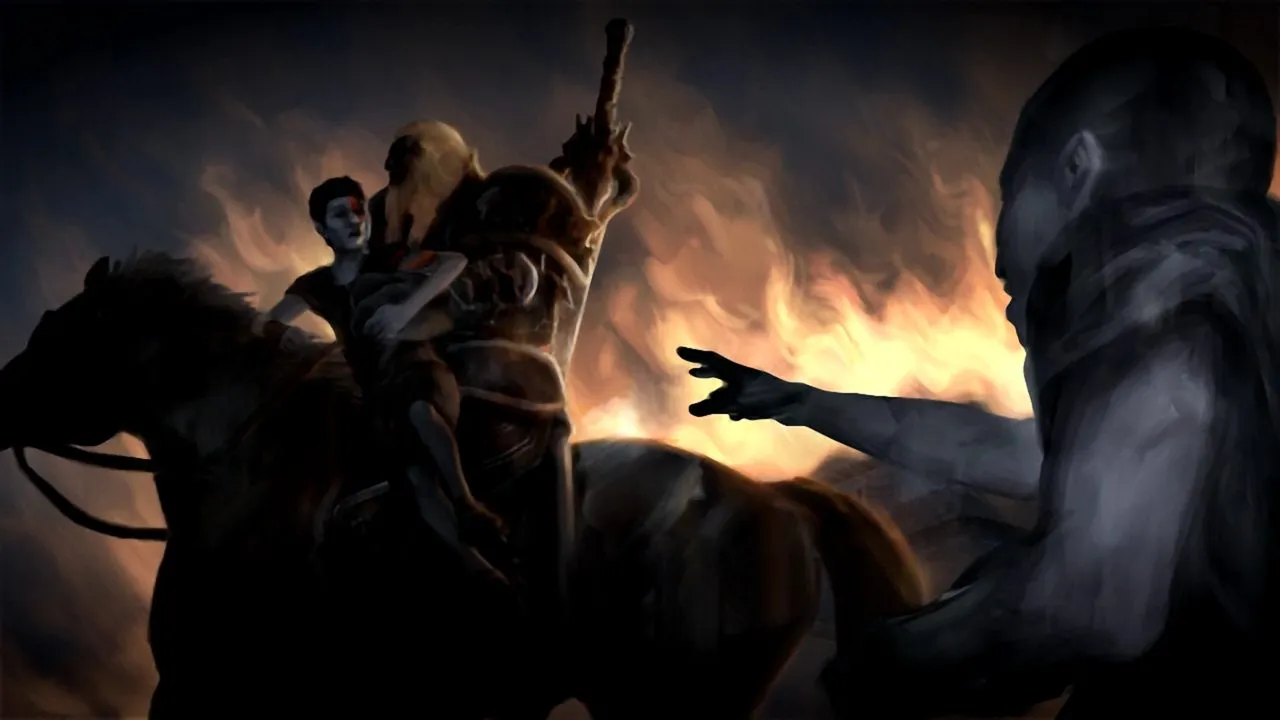
After defeating Ares, Kratos ascends to become the new God of War on Mount Olympus. But the crown brings no peace: he is constantly haunted by visions of his mortal past. Despite the counsel of Athena — the goddess urges him not to dig into the past and not to alienate himself from the gods — Kratos resolves to follow the trail of those nightmares, back to where it all began.
To understand Kratos's nightmare, we must go back many years, to when he and his brother Deimos were two young Spartan boys training in the ways of war. A prophecy from the Oracle had sown fear atop Olympus: the fall of the gods would not come from the vengeance of the Titans — those imprisoned after the Great War — but from a mortal, a "Marked Warrior." Zeus and Ares believed that Deimos — the boy bearing a strange inborn birthmark — was that warrior.
One day, in the middle of the two brothers' training, Ares descended — with Athena at his side. The God of War seized Deimos right before Kratos's eyes. The young Kratos lunged in to stop him and was hurled aside, a long scar slashed across his right eye — the scar Kratos carries to this day. Ares meant to kill the boy too, but Athena stopped him: they had come for the Marked Warrior, not to take a child's life. Deimos was dragged away to the Domain of Death, where Thanatos imprisoned and tortured him for many long years.
In memory of his brother, Kratos tattooed onto his own body a red tattoo identical to Deimos's birthmark. He never knew that this very tattoo — together with another "mark" he had yet to recognize — would make the prophecy come true in the cruelest way imaginable.
Chapter 2: The Temple of Poseidon — The Mother's Secret
The journey into the past leads Kratos to Poseidon's magnificent city of Atlantis. On the way, his ship is attacked and wrecked by the sea monster Scylla — but Kratos is not so easily swallowed by the sea: he drives the beast off and finishes it, setting foot on Atlantis with his fury still unquenched.
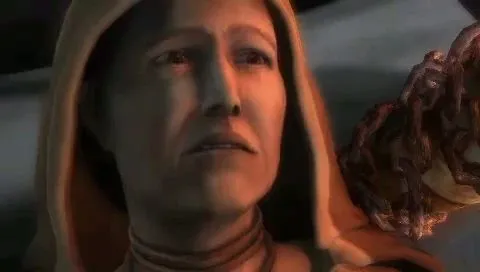
In the Temple of Poseidon, Kratos finds his mother — Callisto — now old and frail, kept confined in this place by the will of Zeus. The reunion of mother and son after so many years apart is filled with tears. Callisto is about to reveal to Kratos the true identity of his father — the secret she has kept her whole life. But just as the words are about to leave her lips, Zeus's curse strikes: her body twists and transforms into a hideous monster.
Kratos is forced to fight his own mother — one of the most painful battles of his life. Before she breathes her last, Callisto returns to human form for a brief moment. She holds no resentment — she thanks her son for freeing her from the curse, then confides the most important thing of all: Deimos is still alive, suffering in the Domain of Death. And before going there, Kratos must visit the Temple of Ares in Sparta.
Chapter 3: The Titan of Fire — Atlantis Drowns in Flames
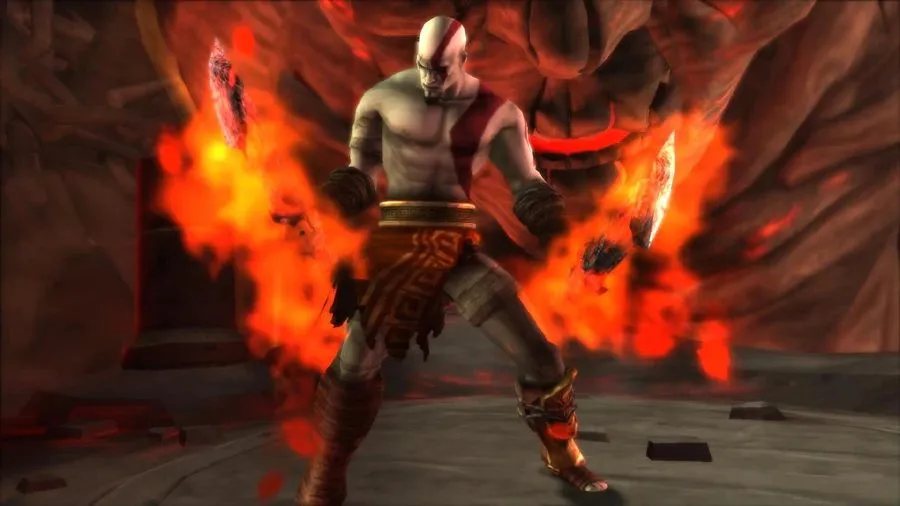
Leaving the Temple of Poseidon with a heavy heart, Kratos finds his way down to the Methana volcano near Atlantis, where the Titan of fire — Thera — is imprisoned by Poseidon beneath the giant screws of Archimedes, guarded by an automaton. "Free me," Thera begs, "free me, and my power shall be yours." Kratos tears apart her chains and rips the power of Thera's Bane straight from the Titan's chest — a fire that can wrap around the Blades of Athena and burn through all armor.
But a Titan's freedom always comes at a price. The Methana volcano roars into eruption, and the splendid city of Atlantis sinks into a sea of fire and collapses to the bottom of the ocean. Poseidon — god of the sea — watches his city destroyed and swears that Kratos will pay dearly. Fleeing the sinking city, Kratos encounters a mysterious gravedigger. The old man warns Kratos not to alienate and provoke the gods — a warning Kratos, as always, ignores.
Chapter 4: Erinys — Daughter of the God of Death
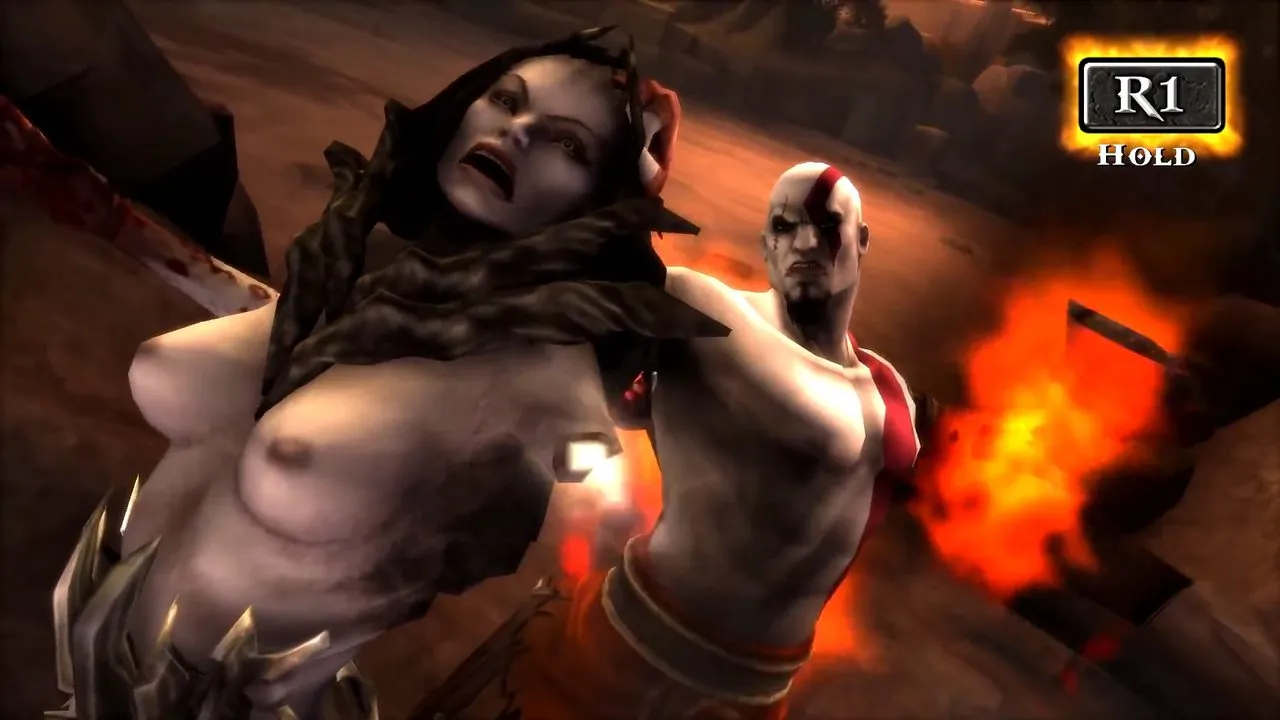
On the road to Sparta, at the treacherous Aronia Pass, Kratos confronts Erinys — the daughter of Thanatos. Ever since the catastrophe of Atlantis, Erinys has hunted Kratos relentlessly, and now she bars his path in the gloomy forest. Erinys is no ordinary opponent: with her monstrous half-human, half-beast form and the power of Death's own bloodline, she drives Kratos into one of the fiercest battles of the journey.
But no one — not even the daughter of the God of Death — can stand before Kratos's wrath when he fights for his family. The duel ends with a brutal finishing blow: Kratos seizes Erinys and snaps her neck in a breathless QTE sequence. From Erinys's corpse, Kratos claims the magic Scourge of Erinys — a power that creates a black vortex sucking in enemies and draining their life force to restore his own. Kratos does not yet know that Erinys's death has just sown another seed of hatred: Thanatos will never forgive the man who killed his daughter.
Chapter 5: Return to Sparta — The Road Down to the Domain of Death
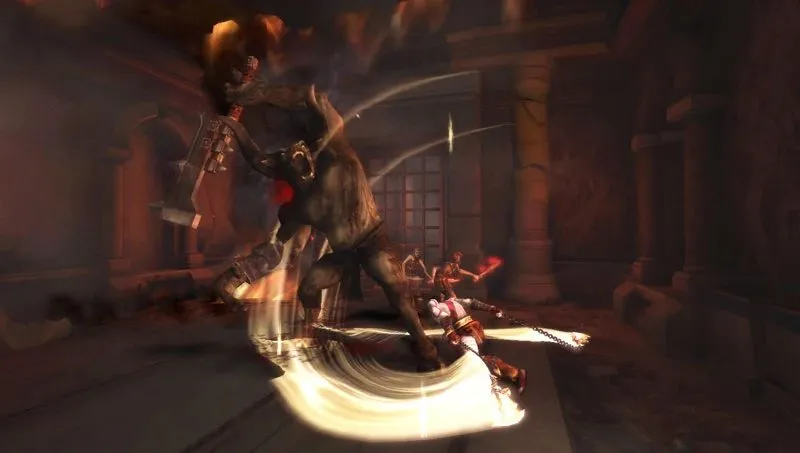
Kratos finally sets foot in Sparta — the homeland he left behind when he was still a mortal warrior. But Sparta has changed: under the leadership of the Last Spartan — the last loyal soldier — the Spartan warriors are tearing down the statue of Ares to raise one of Kratos, the new god of war. His homeland worships him as a god, but Kratos has not returned to receive offerings — he has returned to find the road down to hell.
In the prisons of Sparta, Kratos hunts down a dissident still loyal to Ares. The traitor unleashes the giant Piraeus Lion to kill Kratos — but both the traitor and the beast fall beneath his blades. At the Temple of Ares, Kratos meets a strange figure: the ghost of his own younger self, wandering the ruined temple. From that supernatural encounter, Kratos understands that the road into the Domain of Death lies at Atlantis — the very city he himself sank. Before departing, the Last Spartan returns to Kratos the Arms of Sparta — the spear and shield from his days as Captain of the Spartan army.
Back at Atlantis, now sunk beneath the sea, Kratos's ship is wrecked by Poseidon's minions. Through a possessed statue, Poseidon manifests and declares he will make Kratos pay for destroying his city. But Kratos has no way back: at the Temple of Thanatos on the desolate outskirts of Atlantis, he finds Death's Gate — the entrance to the Domain of Death, where Deimos is imprisoned.
Chapter 6: A Bloody Reunion
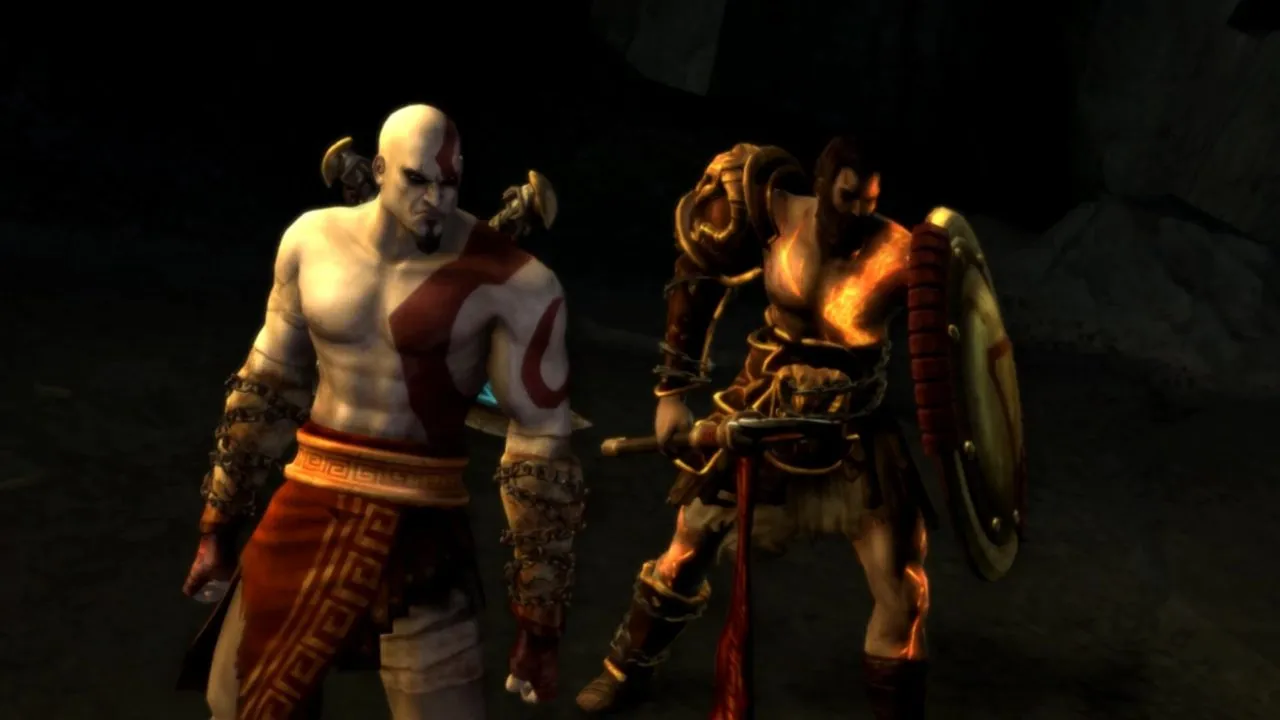
Deep within the dark Domain of Death, Kratos finally finds Deimos — chained and hanging from a withered tree, one arm still locked in a giant iron gauntlet. Years of Thanatos's torture have turned the boy of old into a warrior full of hatred. When Kratos breaks the chains and frees his brother, what he receives is not an embrace of reunion — but a blade pointed straight at him.
"Did you think I would forget? Did you think that I would forgive? I will never forgive you, brother!" — Deimos roars, launching himself at his own brother. In his resentment at being abandoned for so many years, Deimos even defeats Kratos — though everyone understands Kratos held back, unable to strike with full force against his lost brother. At that very moment, Thanatos intervenes: the God of Death seizes Deimos, drags him to Suicide Bluffs — the cliff where Kratos once meant to end his own life — and prepares to hurl him into the abyss.
Kratos forces himself to give chase, covered in wounds. He saves Deimos from falling in time, looks his brother in the eye, and swears he will never abandon him again. Then he hands Deimos the Arms of Sparta — the spear and shield of a Spartan. Before his brother's sincerity, the wall of hatred in Deimos's heart finally crumbles. The two brothers reconcile — and walk side by side into battle against Thanatos, the one who tormented their whole family.
Chapter 7: The Marked Warrior — Thanatos Must Pay
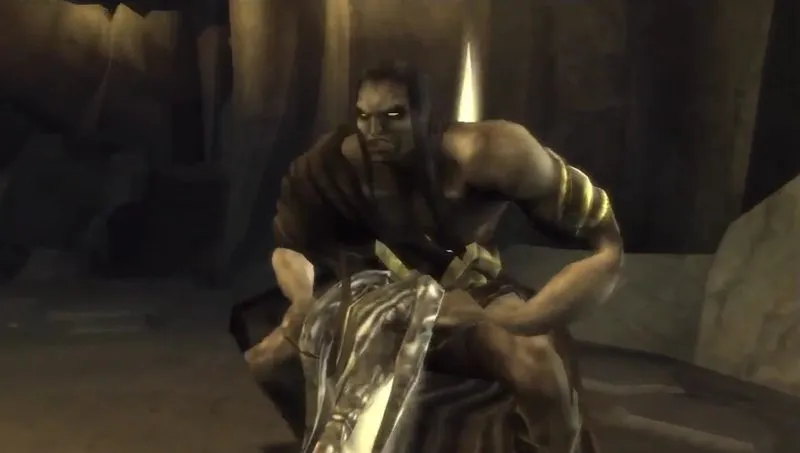
Before the final battle, Thanatos looks upon Kratos and Deimos standing side by side — and suddenly realizes a staggering truth: Ares chose the wrong man. Deimos, with his inborn birthmark, was never the "Marked Warrior" of the prophecy. That warrior is Kratos — with an undeniable double mark: the red tattoo he carved into himself in memory of his brother, and the white ashes of his wife and daughter, Lysandra and Calliope, fused into his skin since that tragic night at Athena's temple, turning him into the "Ghost of Sparta."
Bitterly realizing he had guarded the wrong man all these years, Thanatos bellows and transforms into his true form: a colossal black winged monster, the embodiment of death itself. In his madness, he seizes Deimos, soars into the sky, and crushes him against the cliff face — killing the brother Kratos had only just found again, right before his eyes.
Watching Deimos die horribly, Kratos completely loses control. Every chain of restraint he had kept bursts apart: he unleashes the full measure of his true power, with the flames of Thera's Bane burning without limit around his body. In a state of absolute fury, Kratos hurls himself at Thanatos and destroys the God of Death — avenging his brother with the very hands that had once been powerless to stop him being taken.
Chapter 8: The Graves at Sparta
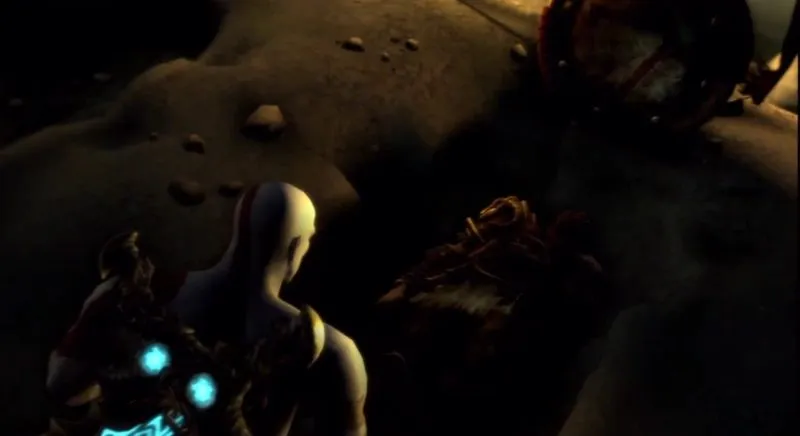
The battle over, Kratos silently carries Deimos's body on his shoulder, climbing the Path of Solitude to the top of Suicide Bluffs. There, the mysterious gravedigger has prepared a grave — right beside the grave of their mother, Callisto. Kratos lays his brother down in his final resting place, plants the spear and shield of the Arms of Sparta in the earth as a headstone, and says that Deimos is finally free.
Gazing at the two graves of his mother and brother, Kratos whispers in agony: "By the gods, what have I become?" The gravedigger answers with a chilling line: "Death... the Destroyer of Worlds."
At that moment, Athena appears. The goddess begs Kratos's forgiveness and offers to raise him to full godhood — a reward for keeping such earth-shattering secrets. But Kratos simply turns his back and returns to Olympus with a new vow carved into his blood: "The gods will pay for this." Athena watches him go and whispers a line Kratos never hears: "Forgive me... brother." It is the first time Athena admits they are siblings — revealing the secret that Kratos is the son of Zeus, something that will be confirmed in the next game.
And in the most haunting post-credits scene of the entire series: the gravedigger silently lays Callisto's body in the grave beside Deimos. Next to those two graves stands a third, empty grave — as if already dug, waiting for someone. The gravedigger looks into that empty space and says: "Now... only one remains." The final scene closes on Kratos sitting in contemplation on the throne of Olympus in newly forged godly armor, his eyes burning with hatred — leading straight into the opening of God of War II, where he leads the Spartan army in an assault on the city of Rhodes.
The Fates of the Characters
Kratos returns to Olympus not as a victorious god, but as a man who has just lost his family a second time. Deimos's death burns away the last bridge between him and the gods of Olympus — the vow that "the gods will pay" paves the way for the war of destruction in God of War II and III.
Deimos — the lost brother — is free for only a few short hours before Thanatos murders him. He is buried beside his mother at Suicide Bluffs, with the Arms of Sparta as his headstone. Deimos's tragedy is the most painful proof of the gods' cruelty: he was abducted because of a prophecy aimed at the wrong man, and tortured his whole life for sins he never committed.
Callisto is freed from Zeus's curse by death at her own son's hands — and she thanked him for it. The gravedigger buries her beside Deimos, so that mother and son are finally reunited in peace.
Thanatos — the God of Death, who imprisoned and tortured Deimos for years — is destroyed by Kratos in a fit of absolute rage. He dies with the bitter knowledge that he and Ares had been guarding the wrong man all along.
Erinys, daughter of Thanatos, falls to Kratos at the Aronia Pass — her death becomes part of what drives Thanatos to resolve to destroy both brothers.
Thera, the Titan of fire, is freed from beneath Mount Methana, but the price is the destruction of Atlantis — and Poseidon's wrath will haunt Kratos for a long time to come.
Athena — who witnessed Deimos's abduction years ago and did not stop it — now carries a burden of guilt, whispering to Kratos the word "brother," powerless to watch anything but him walking the road to Olympus's destruction.
Common Misconceptions
Does Ghost of Sparta take place between God of War 1 and 2?
True, but not the whole picture. Wikipedia places it more precisely: the events unfold between God of War (2005) and Betrayal (2007, the mobile game). Even director Dana Jan himself admitted he wasn't sure where Betrayal sits in the timeline.
Did Ares abduct Deimos all by himself?
No. Athena was actually present at the abduction — she accompanied Ares, witnessed everything, and was the one who stopped Ares from killing the young Kratos as well. Both Wikipedia and the God of War Wiki record this detail.
Is Deimos really the Marked Warrior?
Wrong — that is the story's most ingenious trap. Ares chose the wrong person: Kratos is the true Marked Warrior, and the gods' very scheme to prevent the prophecy is what drove Kratos to become the one who fulfills it.
Are Kratos and Deimos twins?
No. Director Dana Jan has confirmed the two are not twins — Deimos was born a few years after Kratos. Moreover, Deimos's father remains a mystery to this day (only Kratos's father has been confirmed as Zeus).
Did Kratos cruelly murder his mother?
No. Callisto was bound by Zeus's curse: whenever she tried to reveal the identity of Kratos's father, she would transform into a monster. Kratos was forced to act in self-defense and to free her — and Callisto thanked her son before she died.
Is the gravedigger just a mysterious NPC?
No. The God of War Wiki states clearly that he is Zeus in disguise — a detail revealed through the game's Combat Arena mode. The fact that Zeus personally buries Callisto and her son makes the line "Now... only one remains" all the more chilling.
Theories & Mysteries
"Now... only one remains" — who is the "one" that remains? The third empty grave beside the graves of Callisto and Deimos is implied to be meant for Kratos — foreshadowing how Zeus will deceive and "kill" Kratos at the start of God of War II. But the larger question remains open: why would Zeus personally dig the grave and decently bury the mother and brother of the man he tormented? What was the supreme god's true motive in that moment — the game never answers.
The self-fulfilling prophecy. Ghost of Sparta is a perfect illustration of Greek mythology's "self-fulfilling fate" motif: the more the gods tried to prevent the "Marked Warrior" — abducting Deimos, torturing him for years, killing him the moment he was reunited with his brother — the more they drove Kratos onto the path of destroying Olympus. If Ares had never touched Deimos, perhaps Kratos would never have sworn to kill the gods.
Who is Deimos's father? The director would only say it "is a mystery" — Callisto died before she could reveal Kratos's father (Zeus), and no official source has ever mentioned Deimos's father. The fan community has speculated for over a decade and still has no answer.
Why did Thanatos keep Deimos alive to torture him instead of simply killing him? The God of War Wiki suggests the God of Death's motive was to inflict endless suffering on Kratos — turning Deimos into a tool for tormenting the elder brother's spirit. But the game never explains it directly, leaving a frightening darkness around this villain.
👤 Main characters
A quick introduction to the central characters of the story — portraits taken from the game itself.
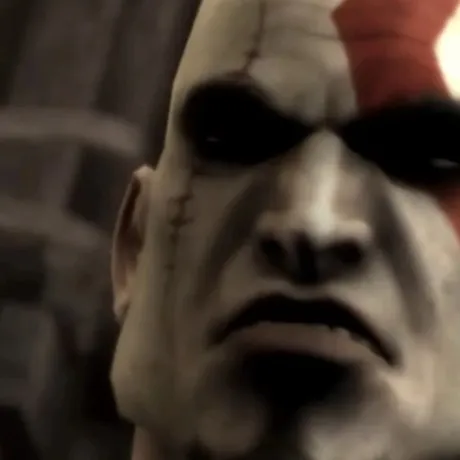
- Epithet
- "Ghost of Sparta"
- Primary weapon
- Blades of Athena (bestowed by Athena)
- Red tattoo
- Tattooed on himself in the pattern of his brother Deimos's birthmark, in remembrance
The new God of War of Olympus, still haunted by visions of his mortal past. Defying Athena's warnings, Kratos journeys back to Atlantis and Sparta to find his lost brother — only to learn that he himself is the "Marked Warrior" of the prophecy. Deimos's death burns away the last bridge between him and the gods.
- Relationship
- Kratos's younger brother by the same mother — the two are NOT twins
- Inborn birthmark
- A strange birthmark that led Zeus and Ares to mistake him for the "Marked Warrior"
- Signature line
- "Did you think I would forget? Did you think that I would forgive? I will never forgive you, brother!"
Abducted by Ares as a small child and imprisoned and tortured for years by Thanatos in the Domain of Death. When his brother frees him, Deimos attacks Kratos out of resentment at being abandoned — but in the end the brothers reconcile and fight side by side. He is killed by Thanatos right before Kratos's eyes, and is buried beside his mother at Suicide Bluffs.
- Zeus's curse
- Whenever she tries to reveal the identity of Kratos's father, she transforms into a monster
- Dying words
- She thanked Kratos for freeing her, and told him to find Deimos in the Domain of Death
- Final resting place
- Buried by the Gravedigger beside Deimos at Suicide Bluffs
The aged mother kept confined in the Temple of Poseidon in Atlantis. When she tries to speak the secret of Kratos's father, Zeus's curse turns her into a monster, forcing Kratos to end his own mother's life with his own hands. In her final moments she bears him no grudge — she thanks her son, and points him toward Deimos.
- Greatest crime
- Imprisoning and torturing Deimos for many years
- Daughter
- Erinys — killed by Kratos at the Aronia Pass
- The truth he realized
- Before the final battle, he admits Ares chose wrong: Kratos is the true "Marked Warrior"
The God of Death who rules the Domain of Death, the one who personally tormented Deimos on Ares's behalf. After Kratos kills his daughter Erinys, Thanatos resolves to take revenge. He dies beneath Kratos's absolute rage, with the bitter knowledge that he had been guarding the wrong man all those years.
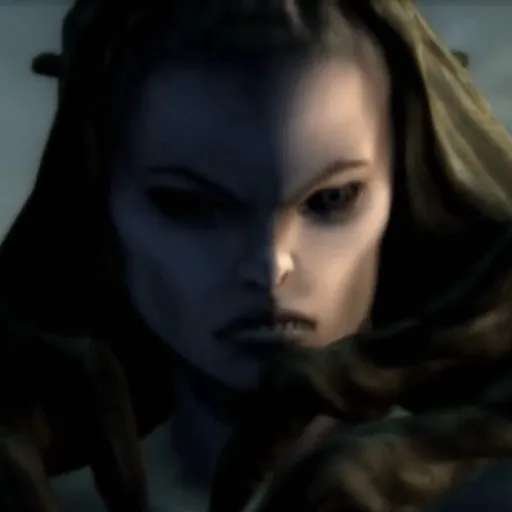
- Identity
- Daughter of Thanatos, the God of Death
- Ability
- Transforms into a giant bird
- Home
- The Domain of Death
Daughter of Thanatos, the goddess of vengeance who hunts Kratos across Atlantis and Sparta for daring to trespass in her father's domain. Erinys transforms into a colossal bird and spreads calamity — and her death at Kratos's hands is the final straw that brings the God of Death himself into the fray.
- Her role back then
- She accompanied Ares during Deimos's abduction; she stopped Ares from killing the young Kratos
- Her whisper at the end
- "Forgive me... brother." — the first time she acknowledges Kratos as her sibling
- The offer refused
- She asked for forgiveness and offered to raise Kratos to full godhood
The goddess who repeatedly warns Kratos not to dig into his past, yet is powerless to stop him from walking the path of confrontation with Olympus. At the end of the game she carries the guilt of having witnessed Deimos's abduction years ago without stopping it — and whispers to Kratos the word "brother," revealing the secret that they share a father: Zeus.
- Prison
- Beneath the Methana volcano, imprisoned by Poseidon and locked down with the screws of Archimedes
- Power granted to Kratos
- Thera's Bane — flames that wrap around the Blades of Athena
- Consequences
- Freeing her destroys Atlantis, and Poseidon swears revenge
The Titaness of fire and volcanoes, imprisoned by Poseidon beneath Methana near Atlantis. Freed by Kratos, she grants him the power of Thera's Bane — flames that burn through all armor, replacing the Rage mechanic of earlier entries. But her freedom is also a death sentence for the entire city of Atlantis.
- His crime in this game
- Abducting Deimos because he mistook the boy for the "Marked Warrior"
- His mark on Kratos
- The long scar across Kratos's right eye, slashed by Ares when Kratos was a child
- Fate
- Killed by Kratos at the end of God of War (2005)
The previous God of War, who appears only through the flashbacks that haunt Kratos. Believing the Oracle's prophecy, Ares abducted Deimos and indirectly destroyed Kratos's entire family — only for that very mistake of "choosing the wrong person" to turn Kratos into the one who fulfills the prophecy and comes back to destroy Olympus.
📚 Read the God of War series in story order
- God of War: Ascension Story Explained: Six Months After the Tragedy and the Three Goddesses of Vengeance
- God of War: Chains of Olympus Story Explained: The Day the Sun Vanished and Kratos's Cruelest Choice
- God of War (2005) Story Explained: Ten Years of Nightmares and the Price of Killing a God
- God of War: Ghost of Sparta Story Explained: The Forgotten Brother and the Prophecy of the Marked Warrior — you are reading this one
- God of War (2018) Story Explained: A Father and Son Scatter the Ashes — and the Name Loki


