Zelda II: The Adventure of Link Story Explained: The Sleeping Princess and the Last Triforce Piece

📋 Quick facts
- Game
- Zelda II: The Adventure of Link
- Developer
- Nintendo R&D4
- Release year
- 1987 (Famicom Disk System, Japan)
- Original platform
- Famicom Disk System
- Genre
- Action RPG, Platform
- Director
- Tadashi Sugiyama, Yasuhisa Yamamura
- Music
- Akito Nakatsuka
- Notable feature
- The only Zelda game with side-scrolling action and an experience-based leveling system
- Next entry
- The Legend of Zelda: A Link to the Past (1991)
Six years after Ganon fell, Hyrule seemed ready to breathe again. But one morning, Link — now 16 years old — woke to a strange mark on the back of his left hand: three triangles arranged as the crest of the royal family. He went to Impa, the elderly nursemaid of the royal household, and the story she told opened an entirely different chapter in Hyrule's history: another princess, a sleeping curse spanning generations, and a third piece of the Triforce that no one had ever touched. That is the beginning of Zelda II: The Adventure of Link, the direct sequel to The Legend of Zelda and the most divisive game in the series' history — the only one to abandon the top-down view for side-scrolling action, to add an experience system, and to make its hero fight his own shadow.
Unlike the first game, where Link only had to gather eight fragments of the Triforce of Wisdom and defeat Ganon, this game sets a more ritual task: carry six crystals into six palaces scattered across Hyrule, unseal the Great Palace, pass its two final guardians, and unite the three pieces of the Triforce to wake the princess. Along the way, Link faces not only the monsters inside the palaces, but also the minions of Ganon — who believe his blood is the one thing that can bring their master back to life.
📌 Quick summary: Six years after defeating Ganon, 16-year-old Link sees the Triforce mark on his hand and learns from Impa about a Princess Zelda from ancient times, sleeping under a magician's curse. To wake her, Link must place six crystals in six palaces, open the way into the Great Palace, and defeat the Thunderbird and his own shadow, Dark Link, to claim the Triforce of Courage. Uniting all three pieces of the Triforce, he returns to the North Castle and wakes the princess, while the plot to revive Ganon with his blood fails completely.
The Mark on the Left Hand
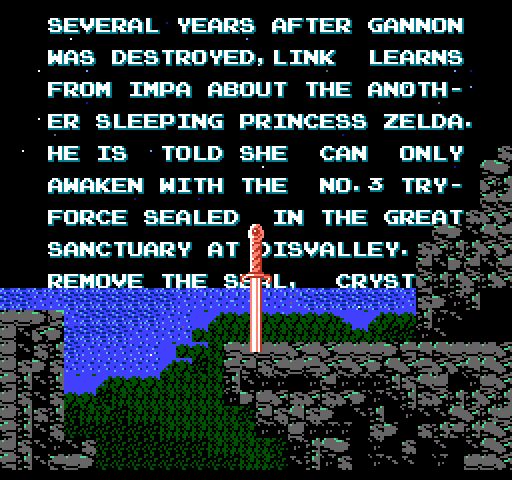
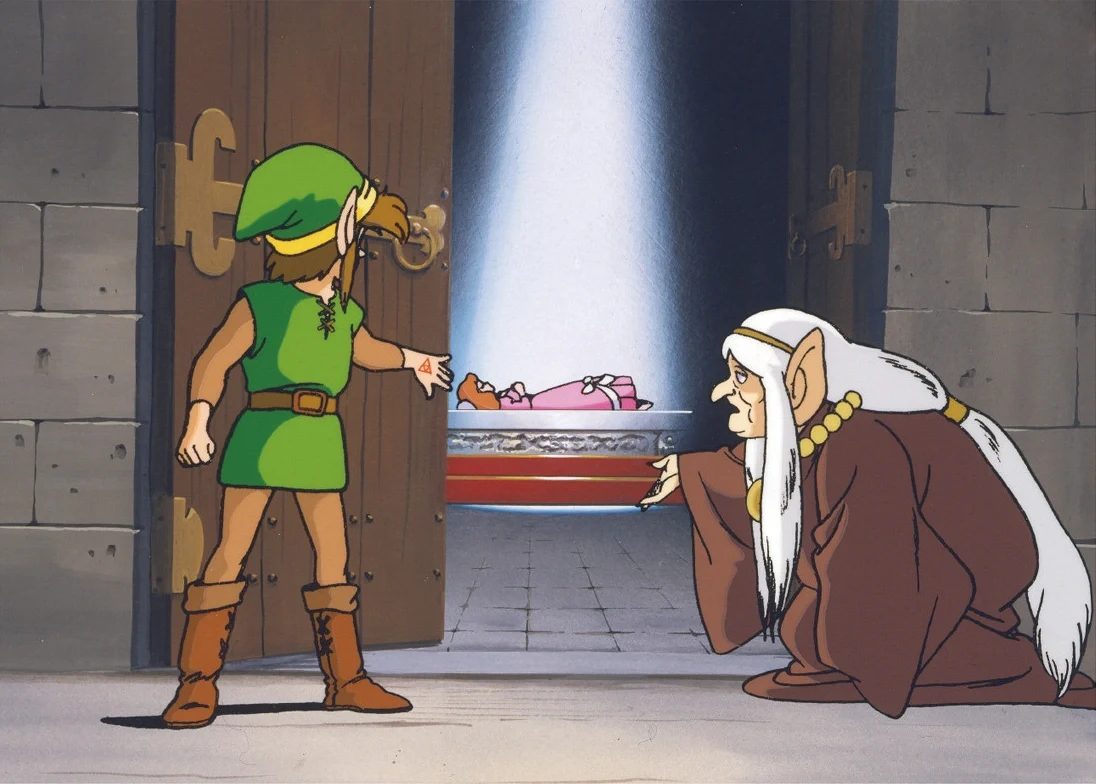
It all begins not with a battle, but with a mark. Link notices a Triforce-shaped crest on the back of his left hand, matching the royal family's emblem. He takes it to Impa, who understands immediately what it means. She leads Link to the North Castle, where a door has been sealed by magic for generations, and no one has been able to open it. When Link presses the back of his left hand against the door, the seal breaks open.
Beyond the door lies a chamber with a young woman sleeping on a stone altar. She is Zelda — but not the Zelda that Link saved in the first game. Impa explains: this is a princess from ancient times, and her tragedy is the very origin of the name Zelda that every royal princess since has carried. This chamber, with its sleeping princess inside, has waited for generations for the one who bears the mark — and that one is Link.
With this, Zelda II establishes a precedent that would define the whole series: every era has its own Link and its own Zelda, and the name Zelda is not merely one person's name, but a memorial kept by the royal family. The mark on Link's hand is also the first time the series asserts the idea of a "chosen hero" — not just anyone can wake the princess, only the one who bears the Triforce mark.
The Curse from the Golden Era
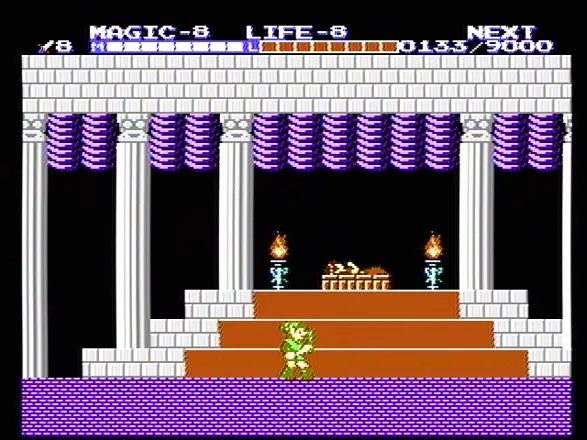
The story Impa tells reaches back to Hyrule's golden era, when the Triforce was used by wise kings to rule the land. The old king hid a third piece of the Triforce — the Triforce of Courage — inside the Great Palace, deep in the Valley of Death in eastern Hyrule, so it would never fall into evil hands. When the king died, his son, the prince, searched everywhere for the missing Triforce, but its location had been told only to the king's daughter, the princess.
Enraged at being left out, the prince had a magician use magic to force the truth from his sister. Zelda refused. In anger, the magician cast a sleeping spell upon her — but the magic was too strong, beyond even its caster's control, and the magician died soon after from his own spell. The prince, filled with remorse but unable to undo the curse, placed his sister in a chamber of the North Castle, hoping she might one day awaken, and decreed that every princess born to the royal family from that day on would be named Zelda, so that this tragedy would never be forgotten.
There was only one way to break the curse: unite the Triforce of Courage with its counterparts — the Triforce of Power, the piece once stolen by Ganon, and the Triforce of Wisdom, the princess's own piece. Impa gives Link a chest containing six crystals and an ancient scroll that, she says, only a future king of Hyrule can read. Strangely, though he has never seen that language before, Link can read the scroll. Its contents lay out the path: place the six crystals into the statues inside six palaces scattered across Hyrule, and the seal of the Great Palace will open — with the Triforce of Courage waiting inside.
The Hero's Blood and the Hunt
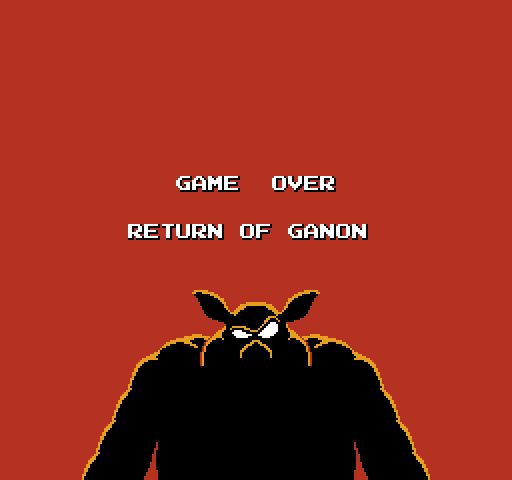
While Link sets out, another danger begins to move. Ganon is dead, but his ashes remain. His minions believe that sprinkling the blood of the one who defeated Ganon — Link himself — over those ashes will revive their master. From then on, the monsters of Hyrule do not merely attack Link by instinct; they hunt him with purpose. Every time Link falls and his lives run out, the game does not end with an ordinary Game Over screen: against a blazing red background, Ganon's dark silhouette appears, laughing, above the words RETURN OF GANON — a chilling reminder that Link's failure means the Dark Lord's return.
This is also the game that changed the series' combat more radically than any other. The world map is still viewed from above, as in the first game, but whenever Link enters a town, a cave, a palace, or touches an enemy on the road, the view switches to a side-scrolling platform perspective. Link has only his sword and shield: he blocks high or low depending on his shield's position, slashes high or low, and can fire a sword beam only at full health. There are no recovery hearts dropped by enemies as in the first game — Link recovers health only by leveling up, using the Life spell, finding fairies, or collecting Heart Containers. Every enemy defeated grants experience points, and when enough are gathered, Link may raise one of three attributes — Life, Magic, or Attack — up to level 8. He begins with three lives, and after maxing all attributes, every 9,000 further experience points grant an extra life.
The journey begins in the town of Rauru, where the first wise man teaches Link the Shield spell, which halves the damage he takes. From Rauru, Link heads into the Parapa Desert to find the first palace. Along the way, he learns to survive under Hyrule's new rules: avoiding unnecessary encounters on the world map, grinding experience from weaker monsters before facing skilled Iron Knuckle knights, and using each spell at exactly the right moment.
The First Two Palaces of Western Hyrule
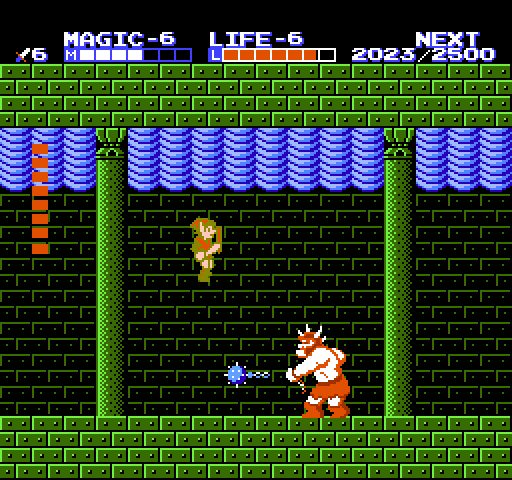
Parapa Palace stands at the northeastern end of the Parapa Desert, its green-brick halls full of traps. Its guardian is Horsehead, a horse-headed warrior wielding a mace, whose only weak point is the top of his head — Link must leap and strike his head while dodging the heavy mace swings. After defeating Horsehead, Link recovers the Candle, which lights the dark caves of the overworld, and places the first crystal into the palace's statue.
Next comes Midoro Palace in the western forests, guarded by Helmethead. Helmethead is a knight whose helmet flies off and circles the room firing magic bolts each time his head is struck — hit him a second time and a second helmet joins the first, and only once both helmets are gone can Link deal real damage. Midoro's reward is the Handy Glove, which lets Link smash blocks inside palaces and open blocked passages.
Between palaces, Link visits towns to learn magic from the wise men: the Jump spell in Ruto (traded for the Trophy found in the Tantari Desert cave), the Life spell in Saria, the Fairy spell in Mido (traded for the Water of Life from the Moruge Swamp cave). Each spell has its own role — Jump clears wide chasms, Fairy turns Link into a fairy to fly through narrow gaps and slip past locked doors, Life saves him in long battles. The towns are also where Link picks up rumors from villagers — including the line that became a legend, spoken by Error in Ruto: "I AM ERROR."
Crossing to Eastern Hyrule
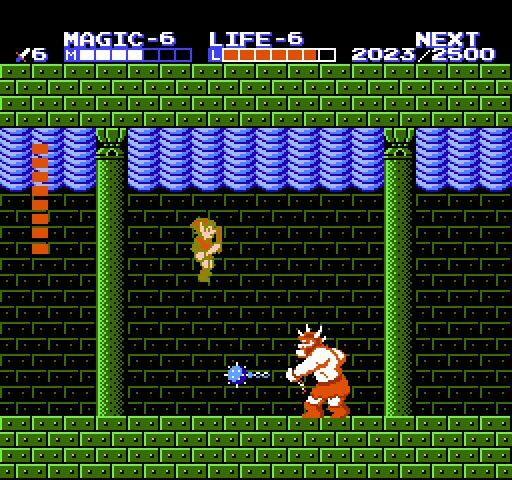
To reach Eastern Hyrule, Link needs the Raft — and to earn it, he must conquer the Island Palace, where Rebonack, an Iron Knuckle riding a ghostly horse, stands guard. The fight with Rebonack is one of the game's hardest: while mounted, he cannot be hurt, so Link must use the Downward Thrust on the horse's head as it charges to knock him off, then duel him on foot. Before that, in a Death Mountain cave, Link found the Hammer, which smashes the boulders blocking paths on the world map — and reveals hidden areas, including the concealed New Town of Kasuto.
The Maze Island Palace comes next, where Carock — a wizard who can only be beaten by casting Reflect so that his own magic bounces back at him — guards the Boots, which let Link walk on water, the key to reaching the Palace on the Sea. That palace's guardian is Gooma, a giant fat man with a ball and chain, and its reward is the Flute: played before the River Devil, the beast blocking the road to southern Eastern Hyrule, it drives the creature away and opens the way.
Along the road, Link also does good deeds for villagers in exchange for magic: rescuing the kidnapped child on Maze Island to learn Reflect in Darunia, finding the Mirror hidden beneath a table in an empty house in Saria, and learning the Fire spell in Nabooru, which turns his sword into a fireball launcher. Every town, cave, and item links into a tight chain of keys and locks: no Hammer, no New Kasuto; no Spell spell, no Magical Key; no Cross, no Thunder spell in Old Kasuto.
The Hidden Palace and the Fire Dragon
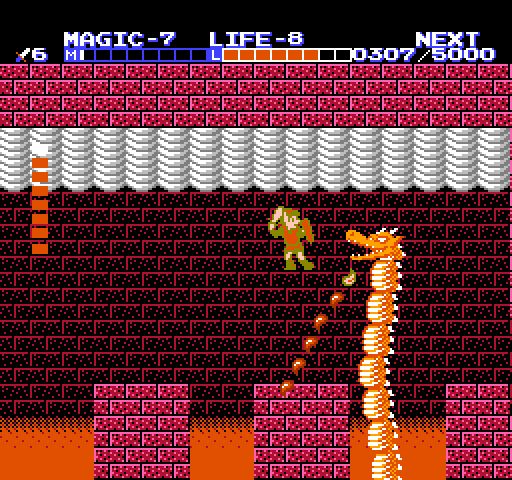
The sixth palace — Three-Eye Rock Palace, also called the Hidden Palace — does not even appear on the map until Link casts the Spell spell at the edge of New Kasuto, raising a small building that holds the Magical Key, the key that opens every locked door. Inside the palace, two more Rebonacks appear as mini-bosses before Link faces Barba, the fire dragon living in the lava. Barba only rises from the molten rock for a moment to spit fireballs, and Link must use Shield and Jump to close in and strike its head the instant it surfaces — being hit risks being knocked straight into the lava.
The sixth palace's reward is the Cross, which lets Link see the invisible Moa ghosts — and, more importantly, opens the way to Old Kasuto, where the final wise man teaches him the Thunder spell. Once all six crystals rest in their six statues, the seal of the Great Palace finally opens. But before stepping inside, Link already holds everything he needs: all eight spells, a full set of equipment, and attributes honed through dozens of levels of experience. The Great Palace is not for the unprepared.
The Great Palace and the Thunderbird
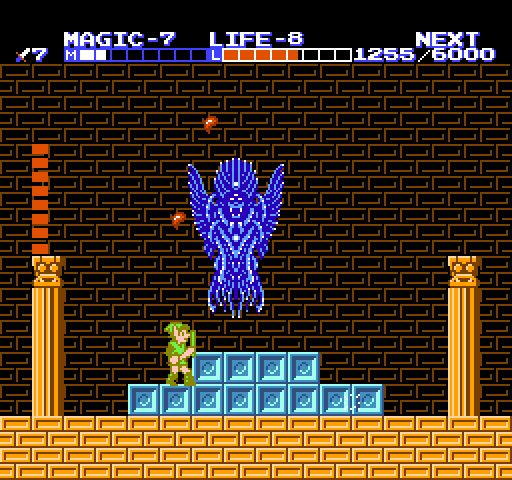
The Great Palace is the game's longest and most brutal dungeon, its halls packed with the strongest monsters, lava corridors, and enemies met before in their most powerful forms. At its end waits the first guardian: Thunderbird, a giant blue thunderbird. Thunderbird is nearly invulnerable — its whole body is armored, and its only weak point, its face, is hidden. The only way to reveal it is the Thunder spell, the most powerful magic Link learned in Old Kasuto: a lightning strike that wipes out every enemy on screen and exposes Thunderbird's face so Link can strike it.
Defeating Thunderbird is not the end. Beyond the final door, in the deepest chamber of the Great Palace, no monster waits — only a dark figure standing in the middle of the room, holding a sword and shield exactly like Link's. It is Dark Link, Link's own shadow, the final guardian of the Triforce of Courage.
His Own Shadow
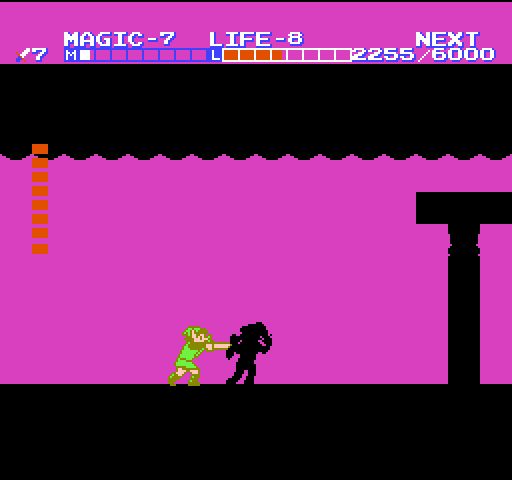
The battle with Dark Link is one of the most famous final battles in gaming history — not for its scale, but for its nature. Dark Link has no moves of his own: he copies every one of Link's motions, with the same speed, the same swordplay, and seemingly the ability to read Link's every intention. Beating him is not about superior strength, but about patience and discipline: shield at the right moment, strike at the right rhythm, and never make a mistake before an opponent who never tires. (In the international NES version, players famously discovered a trick — crouching in the corner of the room and stabbing repeatedly — but in the original Famicom Disk System version, Dark Link is far harder, with no such opening.)
When the shadow dissolves, the Triforce of Courage appears. Link raises the final piece of the Triforce high, and for the first time in the series' history, all three pieces unite into one complete relic. He returns to the North Castle, where the princess has slept for generations, and places the complete Triforce before her. The curse breaks. Zelda opens her eyes — for the first time after a sleep spanning an entire era. The ending screen reads: "YOU SAVED HYRULE AND YOU ARE A REAL HERO!" and the red curtain closes with the words "THE END". Hyrule, the game tells us, enters an era of eternal peace.
But Zelda II's legacy reaches far beyond a happy ending. The towns of Rauru, Ruto, Saria, Mido, Nabooru, Darunia, and Kasuto — names every Zelda II player knows by heart — later became the names of the Sages in Ocarina of Time. Dark Link became a classic character, returning in later entries. The magic system and the Magic Meter introduced here became a permanent part of the series. And in the official timeline published in Hyrule Historia, Zelda II sits in the "Downfall" branch, after A Link to the Past, the Oracle games, and A Link Between Worlds — the latest entry of that branch, closing an era with a long sleep of a princess and her awakening.
Zelda II is also a game that has never stopped dividing opinion: its brutal difficulty made it a textbook case of "Nintendo Hard," and its side-scrolling gameplay almost never returned to the series after A Link to the Past in 1991. Yet with more than 4.3 million copies sold, a 36/40 score from Famitsu, and a fan community that still defends it today, The Adventure of Link deserves to be remembered not as a "black sheep," but as a bold experiment — the game that dared to make its hero fight himself, and dared to tell a story whose heart is not saving the world, but waking someone who fell asleep long before the story began. Readers who want to know how it all started can read the story of the first game, and explore more entries in the same series on the Legend of Zelda series page.
The Fates of the Characters
Link: He fulfills the mission of the marked one. The ancient scroll, readable only by a future king, hints that he is the one who will inherit Hyrule's throne, and waking Zelda is the first step on that path. After Zelda II, this timeline branch tells no more of his story — Hyrule enters peace, and his legend closes with the title of "real hero" on the ending screen.
Princess Zelda: She wakes from a sleep that lasted for generations, from the golden era to Link's own time. She is the first Zelda in royal history — the one every later princess was named after. The moment she opens her eyes is also the moment the old magician's curse, which shaped an entire era of Hyrule, officially ends.
Impa: She completes her role as keeper of the secret. She is the bridge between the sleeping princess's era and Link's era — the one who recognized the mark, opened the sealed door, and gave Link the tools to finish the quest. Once Zelda wakes, her mission of guarding the story is complete.
Ganon: The revival plot fails completely. His ashes remain ashes, and the minions who hunted Link throughout the game never achieve their goal. The laughing silhouette of Ganon on the Game Over screen remains forever a threat — never a reality within Zelda II's story.
Dark Link: He dissolves upon defeat, but the concept of the "hero's shadow" stays with the series forever. He is the final trial the Triforce sets for the worthy, and the precedent for every dark version of Link that appears afterward.
The Prince and the Magician: The prince lives out his life in remorse, his decree naming every princess Zelda serving as an atonement that is never enough. The magician dies in the very moment he casts the spell — magic beyond his control killed its own caster, and neither man's name is recorded by Hyrule's history.
Common Misunderstandings
Is the Princess Zelda in Zelda II the same Zelda as in the first game?
No. They are two completely different people. The Zelda in Zelda II is a princess from ancient times, the only person entrusted by her father with the secret of the Triforce of Courage, who has slept ever since, long before the events of the first game. The Zelda that Link rescues from Ganon in the first game is a different princess living in Link's own time. It was because of the ancient princess's tragedy that the royal family decreed every princess from then on would be named Zelda.
The confusion is understandable, since both are named Zelda and both are tied to Link. But the game states it plainly from the start: Impa tells Link that the sleeping princess is "another Zelda," and the whole story of Zelda II revolves around waking her — not rescuing her from Ganon as in the first game.
Does Ganon actually come back to life in Zelda II?
No. Within the game's main story, Ganon never revives. He died in the first game and only his ashes remain; the whole revival scheme stays at the level of his minions' intent, and they never succeed if the player reaches the end. The image of Ganon laughing on the Game Over screen is not an event in the story, but a warning: if Link fails and runs out of lives, then within the game's world, Ganon will return.
In other words, Ganon in Zelda II is a looming threat, not a character who appears. His weight comes from the player always knowing what failure costs — which is why this game's Game Over screen became so infamous.
Is the Link in Zelda II a different Link from the first game?
No, it is the same Link. Zelda II is the direct sequel to the first game, with the same protagonist, now 16 years old. The game opens by recalling his victory over Ganon, and the minions' entire hunt is driven by that very victory: they want the blood of the one who defeated their master. This is also the first time the series shows a Link growing older over time, rather than each game featuring an entirely new Link.
Is Zelda II a spin-off outside the main storyline?
No. Zelda II is the second mainline entry in the series, developed and published by Nintendo itself, directly continuing the first game's story. It holds an official place in the timeline published in Hyrule Historia, in the Downfall branch, after the events of A Link to the Past, Oracle of Seasons/Ages, and A Link Between Worlds. Its different gameplay makes many mistake it for a spin-off, but story-wise it is an official link in the chain — and the game that closes that branch of the timeline.
Theories & Mysteries
Who are the Prince and the Magician? The game never names either of them, and that may be deliberate: they are not meant to be remembered by name, but by their guilt. A popular theory holds that the magician was one of the court magicians serving the royal family in the golden era — and his death by his own spell is a lesson in arrogance that the series would repeat many times afterward.
Why did the old king tell the secret only to his daughter? The ancient scroll says only a future king can read it, yet the old king told the secret only to the princess. One reading is that the king foresaw his son's greed — and telling the daughter was a test the prince failed. Ironically, that very decision led to the sleeping curse, and it took until Link's era for someone to undo it.
What exactly is Dark Link? The game only calls him Link's "shadow," never explaining his origin. The most widely accepted theory is that Dark Link is the final trial set by the Triforce itself — or by the old king: only one who can defeat himself is worthy of the Triforce of Courage. That also explains why he perfectly mirrors Link's every move: he is not a monster, but a mirror.
What happens after Zelda II? The official timeline stops here for the Downfall branch: once Zelda wakes, Hyrule is described as entering eternal peace, and no game continues this branch. It is one of the series' rare open endings — an era closed not by a new battle, but by a long sleep finally coming to an end.
👤 Main characters
A quick introduction to the central characters of the story.
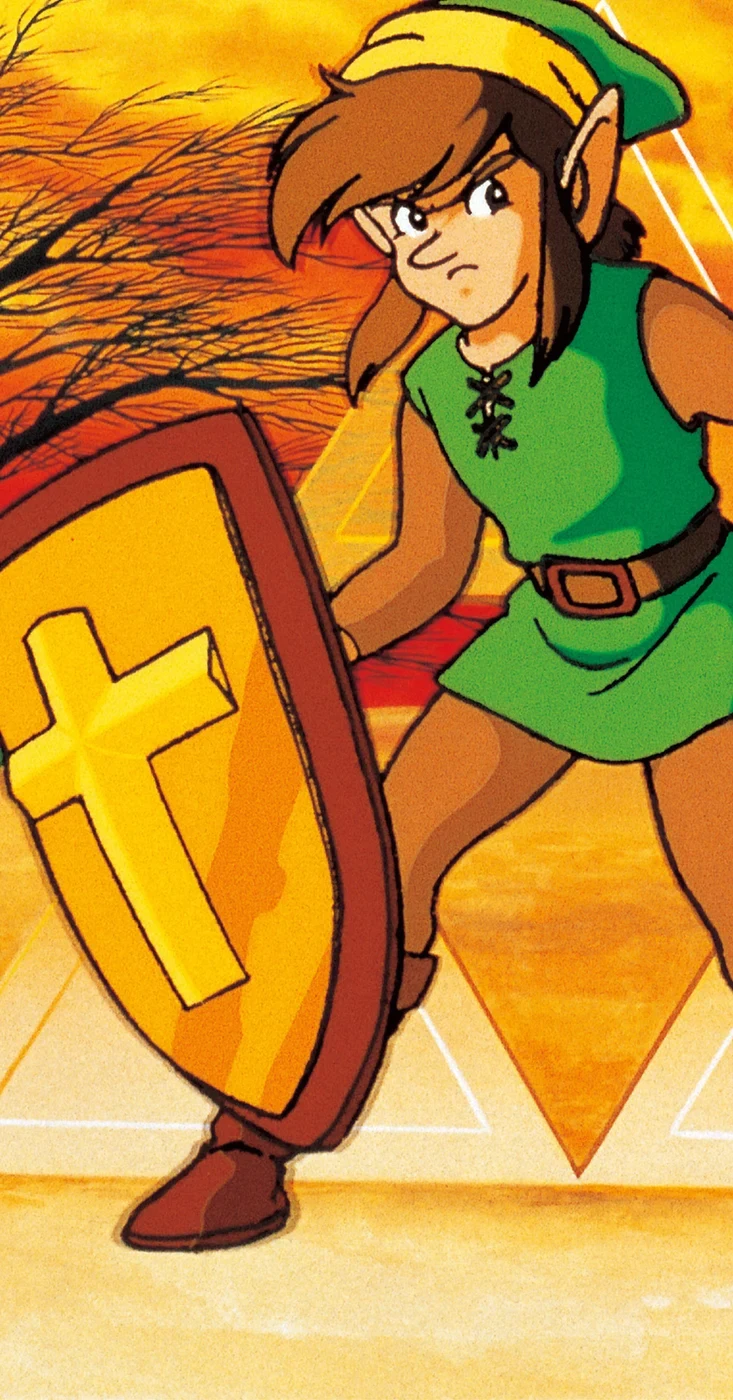
- Age
- 16
- Weapon
- Sword and shield
- Background
- The hero who defeated Ganon in the first game
The young man who defeated Ganon and saved Hyrule in the first game. Six years later, the Triforce mark appears on the back of his left hand, marking him as the one chosen to awaken the sleeping princess. His journey in this game is no longer about saving a kingdom from monsters, but about fulfilling the dying wish of a long-dead king — and facing his own shadow.
📚 Read the The Legend of Zelda series in story order
- The Legend of Zelda Story Explained: Eight Triforce Shards and the Boy Who Saved Hyrule
- Zelda II: The Adventure of Link Story Explained: The Sleeping Princess and the Last Triforce Piece — you are reading this one
