Breath of Fire III Story Explained: The Last Dragon Boy and the Goddess Who Lied to the World

📋 Quick facts
- Game
- Breath of Fire III
- Developer
- Capcom
- Release year
- 1997 — September 11, 1997 in Japan (PlayStation)
- Original platform
- PlayStation
- Genre
- Turn-based JRPG
- Director
- Makoto Ikehara
- Music
- Yoshino Aoki and Akari Kaida
- Notable feature
- The dragon Gene system: collect and combine genes to transform Ryu into many different dragon forms; the story spans two eras, childhood and adulthood
- Next entry
- Breath of Fire IV (2000)
The world of Breath of Fire III was once home to the Brood — dragon-kind who could take the form of colossal dragons and wield power enough to flatten an entire nation. But that was five hundred years ago. When the story opens, dragons survive only as chrysm fossils buried deep in stone mines, excavated by humans and sold like precious ore. No one remembers that dragons once spoke, laughed, and loved — until the day miners dug up a living egg. Breath of Fire III is told in two great chapters — Ryu's childhood and his adulthood — and this article will walk through every leg of the journey, closing with the fate of each character, the lore points most often misunderstood, and the theories the community has debated for nearly thirty years.
📌 Quick summary: Five hundred years after the goddess Myria ordered the extermination of the Brood out of fear of their power, the last egg hatches Ryu — a dragon boy who grows up alongside Rei and Teepo. As an adult, Ryu crosses the Desert of Death to confront Myria and discovers that Teepo has been turned into her instrument. The ending offers two choices: submit to the goddess's protection, or defeat her and let humanity decide its own fate.
Chapter 1: The Young Dragon in the Chrysm Mine
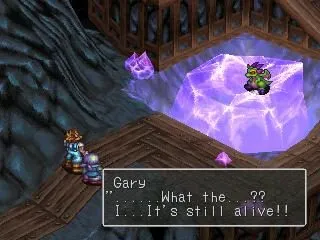
From the fossil egg hatches a small blue dragon. It is locked in a cage and hauled aboard a train crossing the continent, to be sold to the highest bidder. Along the way, the dragon breaks its bars, escapes, and falls into the forest near Cedar Woods, reverting into the form of a blue-haired boy — without a single memory, not knowing who he is, not even able to speak. Two good-hearted local thieves, Rei — a hot-tempered but loyal young man of the tiger clan — and Teepo, a quick-witted orphan boy, find him in the forest, name him Ryu, and take him in as their little brother.
Ryu's childhood passes quietly in the treehouse in Cedar Woods: following Rei and Teepo on their 'jobs' — petty theft to get by, to put it plainly — helping villagers slay monsters, growing up day by day. Those are the only peaceful days the three of them will ever have, and they are the measure of every loss to come: the whole game, in the end, is the story of one small family torn apart by the larger world.
Chapter 2: The Fire That Burned the Treehouse
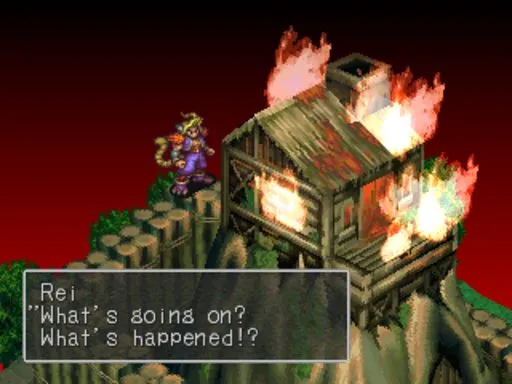
Happiness shatters when the trio inadvertently crosses Balio and Sunder — two half-man, half-horse brothers, enforcers of the criminal organization led by Mikba. During the chase, Ryu's dragon power erupts for the first time, unconsciously, yet still not enough to protect his family. The treehouse is burned to the ground. Rei and Teepo vanish and are presumed dead. Teepo alone, as the truth would only reveal many years later, survived thanks to the latent dragon blood awakening within the flames: he transformed into a dragon in his panic and fled into the deep forest — the beginning of a fate entirely different from the other two.
Ryu wakes up alone and begins wandering in search of his two brothers. Fate leads him to the kingdom of Wyndia: Balio and Sunder capture Ryu, bring him before the king, and brand him a 'devil dragon'. Princess Nina — at this time also just a little girl — is tricked by the horse brothers, unwittingly frees them, and is then kidnapped; Ryu pursues and rescues her. The two children flee the castle together, roam the countryside, and befriend the young engineer Momo and the mysterious onion creature Peco along the way. But freedom does not last: the group is captured again and forced to compete in the Contest of Champions — where the champion, undefeated for many years, is a silent giant of a stone warrior named Garr.
Chapter 3: The Contest of Champions and Angel Tower
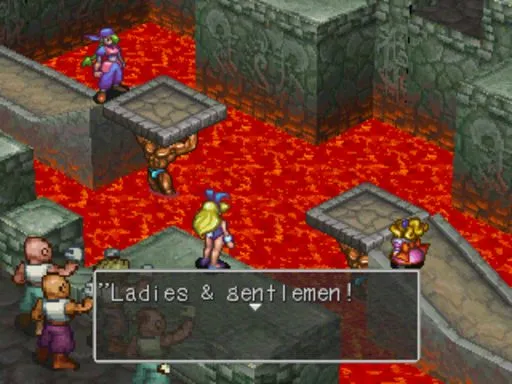
The final match is a one-on-one duel between the boy Ryu and Garr — and Garr wins, as he has beaten every opponent for years. But instead of gold and silver, Garr chooses as his champion's prize Ryu's group itself: he frees them from Balio and Sunder's hands. On the retreat across the bridge at Maekyss Gorge, the group defeats the horse brothers in their fused form, Stallion, and Garr tells Ryu to meet him at Angel Tower in the eastern lands. The villagers think Garr a savior. No one knows he is leading his prey to an execution ground.
For Garr is no ordinary man. He is one of the four Guardians — Garr, Gatz, Gaw, and Gaist — warriors created by the goddess Myria herself five hundred years ago with a single mission: destroy the Brood. At Angel Tower, Garr reveals his intent to kill Ryu — the last dragon he knows of. But what happens is beyond all his calculations: in desperation, Ryu erupts into the berserk Kaiser dragon form, overwhelmingly defeats Garr, then loses control and flies away, vanishing. Garr survives, but carries a question that gnaws at him for years afterward: if a single Brood child could bring him down that easily, then five hundred years ago, why did an entire mighty race of dragons offer almost no resistance when they were slaughtered? He arrives at the only reasonable conclusion: they could absolutely have killed every Guardian if they had wanted to — and they chose not to.
Chapter 4: Adulthood — Garr Returns to Apologize
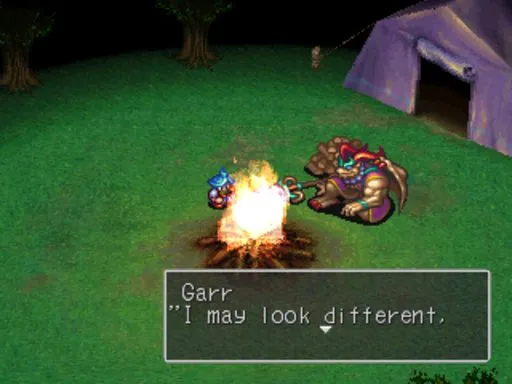
Many years pass. Ryu, the boy of those days, has become a young man, living quietly after the rampage at Angel Tower. After years of searching, Garr follows rumors of a dragon appearing again and finds Ryu — but this time he does not raise his weapon. He apologizes for the massacre of long ago, and asks Ryu to go with him to the very end of the truth: to ask the goddess Myria herself why the Brood had to die. Ryu agrees. The adult journey opens here, and one by one the old friends return: Nina is now a grown princess, strong and resolute, defying her royal father's objections to accompany Ryu. And the greatest surprise: Rei is still alive.
After the night the house burned, Rei survived and spent years alone hunting Mikba to avenge his family. When Ryu and Garr find him, Rei is confronting the entire criminal organization; together the group brings Mikba down, closing a blood debt stretching back to childhood. But the one all three truly want to find — Teepo — remains without a trace. The group goes on to welcome back Momo, now a researcher at the Plant Institute, and Peco, the strange little creature who often 'talks' with the god-tree Yggdrasil — the ancient entity guarding all life in the world. Through the witch Deis — the mysterious sister of Myria herself — the group learns where the goddess dwells: to meet Myria, they must cross the sea to the forgotten northern continent.
Chapter 5: Dragnier — The Last Village of the Dragons
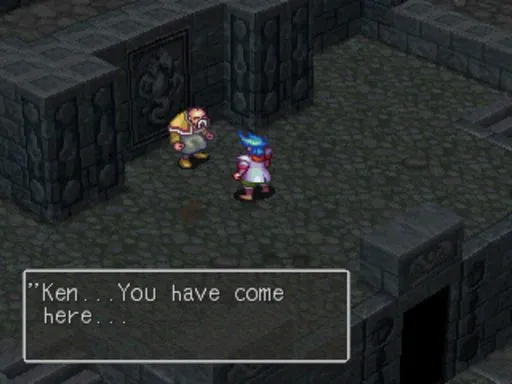
The northern continent is a museum of everything Myria erased: towns full of abandoned ancient technology, and deep in the dead lands lies Dragnier — the village of the last surviving Brood descendants. Here, a great truth is revealed: the Brood were not completely extinct. A portion of them survived the massacre by voluntarily giving up their dragon power, hiding at Dragnier for five centuries. The people of Dragnier also tell that Myria is the very 'goddess' the heroes defeated in the first Breath of Fire — and, in their words, she has never forgiven the dragons. This is also the answer to Garr's torment: the dragons did not fight back not because they were weak, but because they understood better than anyone — an all-out war between dragonkind and the goddess's army would drag the whole world into the grave. They chose to suffer death and oblivion in its place.
From Dragnier, the only road to Myria leads through the Desert of Death — a colossal dead land that has kept spreading throughout the era of her rule. Beyond the desert lies Caer Xhan, once a glorious city of technology, now only ruins, where an ancient elevator system carries Ryu's group upward to Myria Station — the fortress floating in the sky, the 'heaven' the goddess built to govern the world. The closer they draw to their destination, the more Ryu senses that this place bears the traces of the person he has searched for half his life.
Chapter 6: Teepo — The Brother Who Chose the Cage
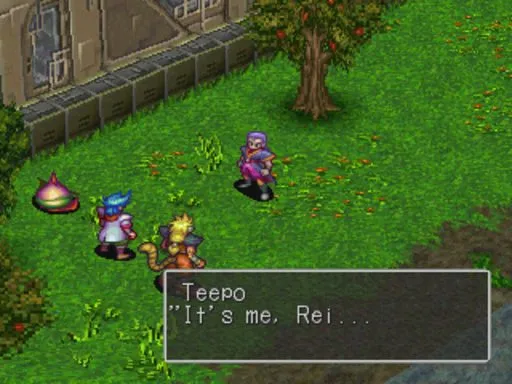
The premonition is right. In the Eden garden of Myria Station, Ryu meets Teepo again — now a grown young man with purple hair. The brother of those days did not die in the flames: his latent dragon power saved him, and after years of wandering alone with no home and no family, Myria herself found him and brought him to the station. She convinced Teepo that the Brood's power is a curse that brings only war and death, and that the only way to 'protect' the world is to imprison himself forever in this safe cage. Teepo believes it with all his heart — and believes Ryu should stay here like him.
The two brothers stand on opposite sides of the line, not out of hatred, but because they chose two different answers to the same fear. When words fail to sway Ryu, Teepo transforms into the Dragon Lord — a colossal adult dragon form — and throws himself into a life-or-death battle with his own little brother. Teepo loses. In his final moments, the shell of conviction collapses: he confesses that the only thing he truly ever wanted was to return to the days when the three brothers lived together in the treehouse. Then Teepo closes his eyes, reverts to the form of a young dragon, and fades away — leaving Ryu a grief nothing can repay, and the resolve to walk the rest of the road.
Chapter 7: Facing the Goddess — and Two Endings
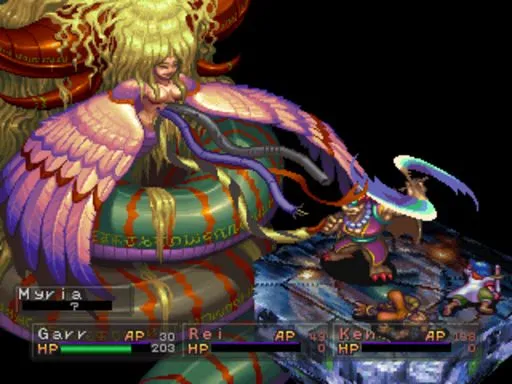
Myria receives Ryu in the station's central control room, and she is nothing like a typical villain. She calmly lays out her reasoning: she has seen with her own eyes what the Brood's power can do to this world. She is also the one who stripped advanced technology from humanity's hands — for the same reason: the ancient civilizations of the northern continent once drove themselves to the brink of extinction with their own inventions. Everything she has done, from the genocide of the dragons to building the religion and the world order of today, serves a single purpose: to protect frail living beings from their own capacity for self-destruction. In her eyes, this world needs a strict mother — and she has taken that role upon herself.
At that very moment, the voice of the god-tree Yggdrasil rings out through Peco — the rare ancient entity who dares speak plainly to the goddess: she has gone too far. A mother, no matter how loving, must eventually let her children walk on their own feet and take responsibility for their own choices. Then Myria offers Ryu the very proposal she once made to Teepo: stay in Eden, live in peace forever under her protection — and the game hands the decision to the player. If you accept, Breath of Fire III ends right there with an ending so cold it chills the spine: Ryu remains in the artificial heaven, and the final line reads only: 'And so time passed... never changing...'
If you refuse — as most players did — the final battle with the goddess erupts, and Myria is defeated. In the station's final moments, Deis appears beside her sister and declares: the age of gods meddling in the world has ended; from now on the world belongs to humanity itself. Ryu's group escapes the collapsing Myria Station in time — all but one. Garr stays behind. A Guardian's life is bound to the goddess who created him, and Garr — the one who bore the guilt of the massacre for five centuries — turns to stone amid the ruins of the station as a final atonement, under the helpless gaze of Ryu and Nina. From here on, the world has no gods to shelter it, and no devil to blame: for the first time, humanity must take responsibility for its own destiny. That is why, after nearly thirty years, this is still regarded as the most mature and haunting story in the entire series.
The Fates of the Characters
Ryu — survives the final battle and crosses the desert with his friends on the road home. He is still a Brood bearing the full power of dragons, but the first Brood in five centuries to live in a world where no one orders him killed or caged.
Nina — survives and returns to Wyndia. The journey with Ryu transforms her from a runaway princess into a worthy heir: one of the rare royals who has seen the outside world with her own eyes, and the truth about the goddess.
Rei — survives. After helping the group bring down Mikba and repay the blood debt for the house of those days, Rei stays at Ryu's side until the final battle. Of the three Cedar Woods brothers, he is the only one left alive to tell the story.
Teepo — dies at the hands of his own little brother in his Dragon Lord form at Eden. Teepo's death is the central tragedy of this game: he did not lose because he was weak or evil, but because he let fear and loneliness convince him to give up his freedom.
Garr — turns to stone as Myria Station collapses. The last Guardian closes his five-century life with an act of atonement; his whole life is proof that a killing tool can still learn again how to be human.
Momo and Peco — both survive. Momo continues her research in a world that will soon have to reinvent everything itself. Peco remains the bridge between humanity and the god-tree Yggdrasil — and the one who spoke for the whole world at its most decisive moment.
Myria and Deis — the two divine sisters withdraw from the world with the station's collapse. The game never confirms that Myria died in the ordinary sense: she is an ancient entity who was defeated once before in the series' history and still returned.
Balio, Sunder, and Mikba — the horse brothers died in their fused form, Stallion, back when Ryu was still a child; and Mikba, the one behind every tragedy of the three brothers, is destroyed by Rei and the group in the adult chapter.
Lore Points Often Misunderstood
Is Myria an evil goddess hungry for power?
Not quite. Myria does not rule to enjoy power: she truly believes she is a mother protecting her frail children, and her fear has grounds — both the Brood's power and ancient technology once nearly destroyed the world.
This is the most common reading, but it does not match what the game shows. Myria does not rule to enjoy power: she truly believes she is a mother protecting her frail children, and her fear has grounds — both Brood power and ancient technology once nearly destroyed the world. What is frightening about Myria is her absolute overprotectiveness: she does not allow humanity the right to make mistakes. Notably, the game even shows Myria praying by herself — an omnipotent god would not need to pray to anyone; this small detail shows that even she is uneasy about the path she chose.
Is Ryu really the last dragon?
Only half true. Ryu is the last Brood still holding dragon power that the outside world knows of, but Teepo is also a genuine Brood, and an entire Brood community still lives at Dragnier — they have merely given up their power. The title 'the last dragon' used by the Guardians is the hunter's point of view, not the whole truth.
Were the dragons wiped out because they were too weak?
The complete opposite. Garr concludes it himself: a Brood child like Ryu was enough to defeat the strongest Guardian, so the dragon race at its peak could absolutely have swept away Myria's army. They did not fight back because the price of an all-out war would have been the whole world — and they chose to take the loss upon themselves.
Is Teepo a traitor?
Teepo never betrayed anyone out of ambition or hatred. He was an orphaned child isolated for years, 'saved' by the goddess and indoctrinated with an ideology through feigned care. The final battle between the two brothers is, in essence, a war between two victims of the same hand.
Is the Desert of Death purely a natural phenomenon?
That dead land is the wound of the world bound to the era of Myria's rule — and the clearest proof is that after she withdrew, the god-tree Yggdrasil began bringing life back to the desert, as witnessed by the characters themselves. The world of Breath of Fire III did not 'die' by nature; it died slowly because it was governed by fear.
Community Theories and Debates
Did Myria truly die? This is the question fans have debated the longest. In the first Breath of Fire, Myria was defeated and sealed away once, yet still returned in Part III. Thus, part of the community believes Part III's ending is only her second retreat — and that what truly ended her age was Deis's declaration of leaving the world to humanity, rather than a physical death.
Is Teepo still alive? One detail has kept fans hoping for years: Rei and Teepo appear as cameos in Breath of Fire IV's endgame content. The majority opinion holds that this is merely a gift for fans, not part of the official storyline; but not a few cling to it to believe Teepo somehow survived. Capcom has never confirmed — and perhaps that ambiguity is exactly what makes this character so haunting.
Are the Ryus across the series the same person? Every Breath of Fire entry has its own Ryu and Nina, splitting the community into two camps: one believes they are different lives of the same two souls across the ages; the other holds that this is merely the series' naming tradition, and the games take place in independent eras — except for the clear link of Myria and Deis between Parts I and III. Capcom has stayed strategically silent for nearly thirty years, and the debate has yet to end.
Source note: This article was cross-checked in detail against the Breath of Fire Wiki and the Capcom Wiki (Breath of Fire III entries) — especially on the milestones: the Contest of Champions and the role of the four Guardians, the truth at Dragnier, both of the game's endings, and the fates of Teepo and Garr at the journey's end.
👤 Main characters
A quick introduction to the central characters of the story — portraits taken from the game itself.
- Race
- Brood (dragon clan)
- Trait
- Can transform into a dragon
- Raised in
- A mining village
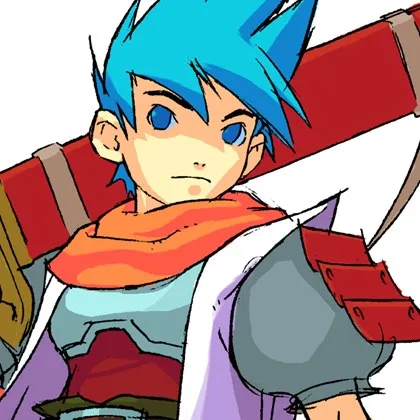
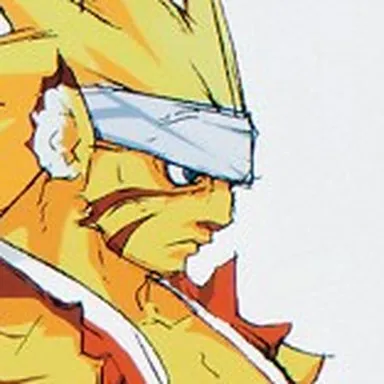
A young dragon boy who emerged from a chrysm mine and grew up alongside Rei and Teepo. As the last descendant of the Brood hunted by the goddess Myria, Ryu is forced to grow up amid a war of the gods.
- Race
- Weretiger
- Trait
- Transforms into a tiger in battle
- Role
- The one who looks after the young group
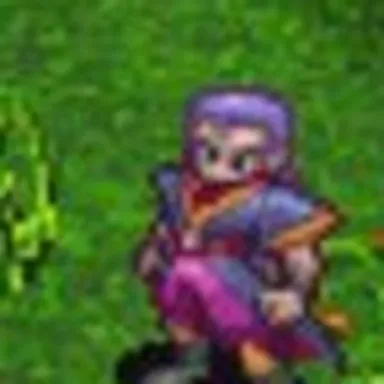
A quiet, pragmatic weretiger young man — the one who always shoulders responsibility for the whole group. The treehouse fire and his presumed death are the greatest wound of Ryu's childhood.
- Race
- Carries dragon blood
- Trait
- Can transform into a dragon
- Later becomes
- Emperor of the empire
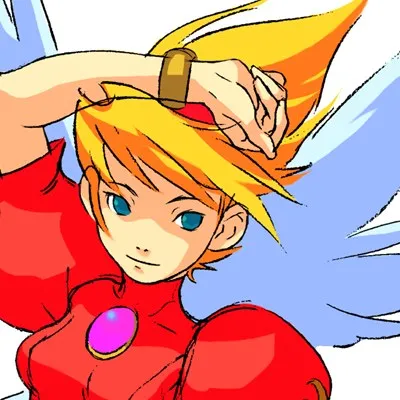
A cheeky boy who loves to tease but is devoted to his friends. After the fire, Teepo is granted power by Myria and becomes emperor — only to finally face Ryu in the form of the Dragon Lord.
- Origin
- Wyndian royalty
- Specialty
- Wind magic
- Weapon
- Magic staff
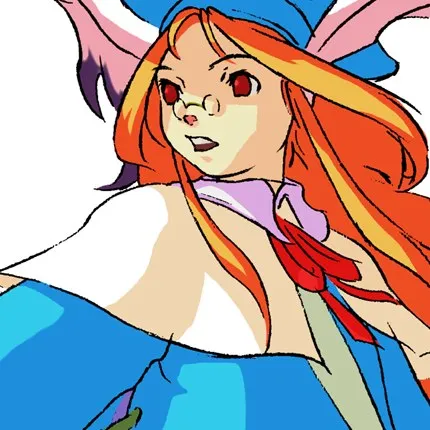
The princess who fled the royal palace to seek the truth, accompanying Ryu from after the Contest of Champions. Though of noble birth, Nina chooses the adventuring road together with her friends.
- Father
- The engineer Repsol
- Weapon
- Bazooka
- Home
- Her father's tower
A cheerful, machinery-loving girl, daughter of the great engineer Repsol, living in the tower full of machines her father left behind. Momo joins the group after they help her clean up the chrysm plant.
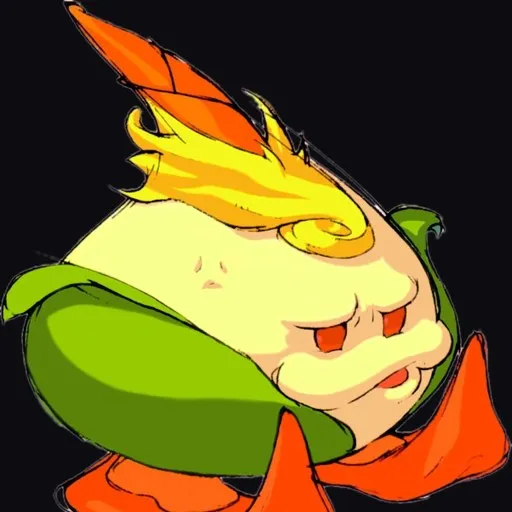
- Race
- Onion
- Origin
- Born from an experimental seed at the plant factory
- Trait
- Can only say a few simple words
An onion creature born from a plant cross-breeding experiment, able to say only a few simple words but possessed of uncannily resilient vitality. Peco joins Ryu's group like a child curious about the world — and his innocence repeatedly touches truths that the adults in the group avoid.
- Race
- Urkan (lion warrior)
- Former master
- The goddess Myria
- Weapon
- Greatsword
An ancient warrior who served the goddess for hundreds of years and once took part in slaughtering the dragon race. After the match at the Contest of Champions, Garr joins Ryu's group — and gradually begins to question the orders he obeyed his whole life.
- Title
- Goddess
- Goal
- Exterminate the dragon race
- Abode
- The heavens
The supreme deity obsessed with the notion of 'protecting the world', who ordered the total extermination of the Brood out of fear of their power. The final confrontation with her opens two different endings for the fate of the world.